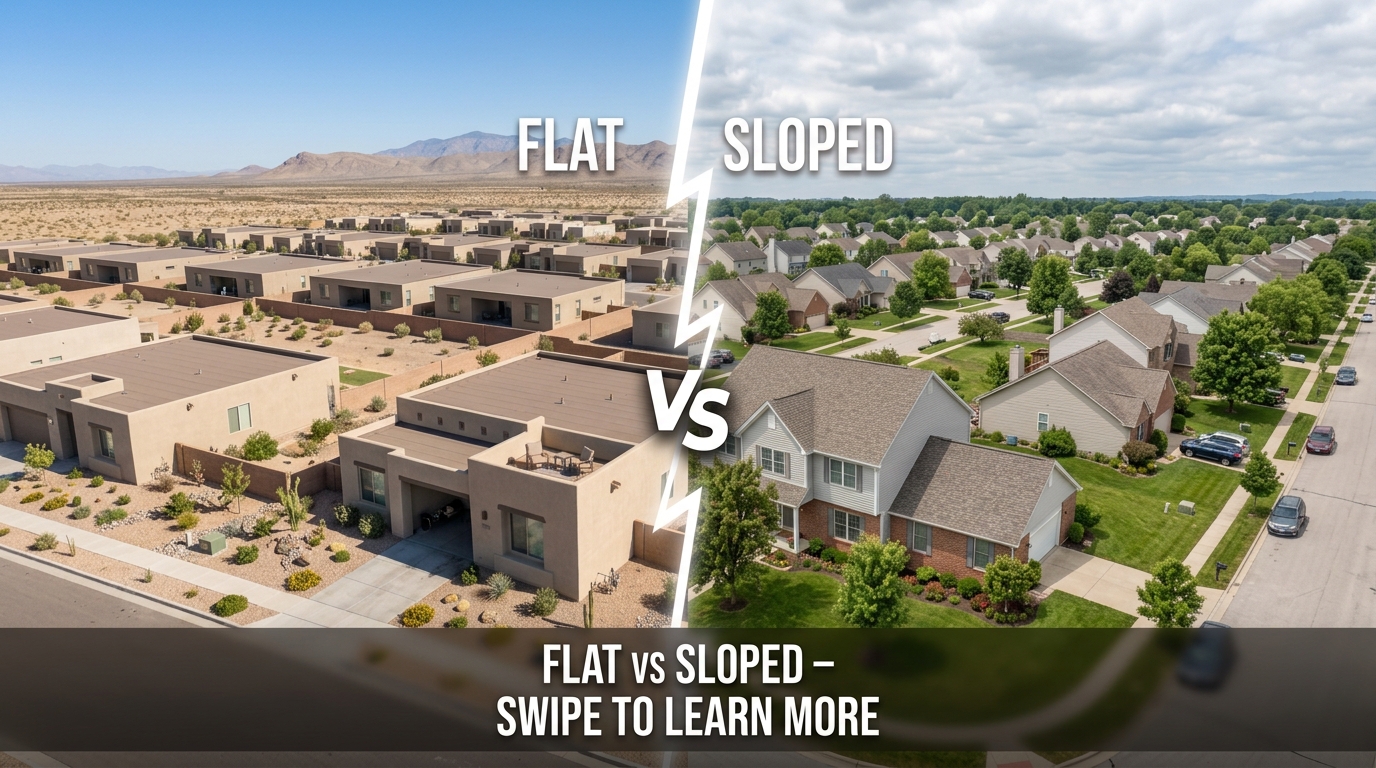
Are you building from scratch or planning a major home renovation? One of the toughest—and most critical—decisions homeowners face is choosing between a flat roof and a sloped (pitched) roof.
This isn’t just about curb appeal. Your choice impacts your budget, energy efficiency, maintenance workload, and even your home’s resale value.
As roofing professionals, we know there’s no one-size-fits-all answer. The best choice depends on your climate, budget, and lifestyle. To help you make an informed decision, we’ve put together this complete guide breaking down the pros, cons, and key considerations for each system.
1. Flat Roofs (Low-Slope or Deck Roofs)
Flat roofs are iconic in modern and minimalist architecture, and they are especially common in arid regions or areas with mild weather conditions.
✅ Pros (Advantages)
- Usable space: The biggest advantage is that you can turn your rooftop into a functional living area—think patios, rooftop gardens, barbecue spaces, or even a deck for your outdoor furniture. Installing solar panels is also much simpler and more cost-effective.
- Easy access and maintenance: Walking on a flat roof is safe and straightforward. Inspecting membranes, cleaning drains, or servicing HVAC units installed on the roof is much easier compared to steep slopes.
- Faster construction: Flat roofs require less structural carpentry (fewer rafters and trusses). This usually translates to lower initial material and labor costs.
- Modern aesthetics: Their clean, geometric lines fit perfectly with contemporary, industrial, and minimalist home designs.
❌ Cons (Disadvantages)
- Critical drainage: Water doesn’t have gravity working in its favor to run off quickly. If the drainage system (internal scuppers or slight sloping) fails or gets clogged, water pools on the surface. This leads to leaks, membrane deterioration, and structural damage over time.
- Shorter lifespan: In regions with heavy rain, snow, or intense UV exposure, flat roof membranes (like modified bitumen, EPDM, or TPO) tend to wear out faster. Average lifespan is 15 to 25 years, compared to 30+ years for quality sloped roofs.
- Debris accumulation: Leaves, dust, and dirt build up easily. This demands consistent maintenance (cleaning every 3–6 months) to prevent drains from clogging and water from ponding.
2. Sloped Roofs (High-Pitch or Steep-Slope Roofs)
This is the classic “storybook” or “A-frame” roof. It is the most common choice in humid, cold, or snowy regions, and includes materials like asphalt shingles, metal, slate, or clay tiles.
✅ Pros (Advantages)
- Natural, efficient drainage: Rainwater and snow slide off effortlessly thanks to gravity. This drastically reduces the risk of leaks, moisture intrusion, and mold growth—provided the installation is done correctly.
- Superior durability: Depending on the material (especially premium shingles, metal, or slate), a sloped roof can easily last 30, 40, or even 50+ years with minimal maintenance.
- Passive ventilation: The space between the roof deck and the ceiling (the attic) creates an air chamber that naturally regulates indoor temperatures. In summer, it vents out trapped heat; in winter, it helps retain warmth inside your living spaces.
- Endless aesthetic versatility: Available in thousands of colors, textures, and profiles. You can mimic wood shakes, slate, or give your home a rustic, colonial, or Mediterranean look without sacrificing performance.
❌ Cons (Disadvantages)
- Higher upfront cost: Sloped roofs require more lumber (structural framing), more specialized labor, and often seismic or wind-load reinforcements. This significantly increases the initial investment.
- Riskier maintenance: Walking on a steep slope is dangerous. Cleaning gutters and inspecting for damaged shingles typically requires safety equipment or hiring a licensed professional. DIY repairs are not recommended.
- Limited usable space: The attic space is rarely suitable as a livable room (unless you install dormer windows). It usually ends up as storage space or a crawlspace for ductwork and wiring.
3. Quick Comparison Chart
| Feature | Flat Roof | Sloped Roof |
|---|---|---|
| Initial Cost | Lower | Higher |
| Average Lifespan | 15 – 25 years | 30 – 50+ years |
| Maintenance | Frequent (cleaning & resealing) | Low (annual inspections) |
| Thermal Efficiency | Fair (requires extra insulation) | Excellent (natural air pocket) |
| Usable Space | Rooftop deck / garden | Attic for storage |
| Leak Risk | High (if drainage fails) | Low (gravity-assisted runoff) |
| Architectural Style | Modern / Industrial | Classic / Colonial / Rustic |
4. So, Which One Should You Choose?
At Bernal Roofing Systems, we never recommend a solution based on trends alone. Here is our professional rule of thumb:
- Choose a flat roof if you live in a dry, desert-like climate, have a tighter construction budget, and dream of having a rooftop terrace, garden, or solar array. Crucial: Make sure you hire a specialist in waterproof membranes and drainage design—this is non-negotiable.
- Choose a sloped roof if you live in areas with heavy rainfall, snow, or hurricane-prone zones. Also, choose this if you are looking for a long-term investment with minimal upkeep and want to maximize your home’s energy efficiency naturally.
The biggest mistake is choosing based purely on aesthetics without considering your local weather patterns. A sleek modern terrace in a rainy region will become a constant headache, just as a steep shingle roof in a desert climate can drive up cooling costs if not properly insulated.
5. Still Undecided? Let Us Help You!
At Bernal Roofing Systems, we don’t believe in one-size-fits-all solutions. That’s why, before we recommend any system, we conduct a thorough on-site assessment of your property, local climate, and budget.
✅ Want a personalized, no-obligation consultation?
Call us today at (619) 675-6316 or click the button below to schedule your free roof inspection. Our specialists will visit your home, answer all your questions, and deliver a tailored diagnosis with transparent pricing.
📞 Phone: (619) 675-6316